Gait and Trajectory Optimization for Bipeds
Abstract
This project implements trajectory optimization on a 5-link kneed bipedal walker. Generated both periodic and non-periodic gaits for flat and uneven surfaces including sinusoidal, staired, and sloped terrains. Also developed understanding of non-linear dynamics and chaos theory for passive walking.
Implemented trajectory optimization using direct collocation methods. Developed a two-link passive walker and simulated it on MATLAB to understand chaotic dynamics and bifurcation behavior.
Note: This project is no longer maintained.
5-Link Biped Model
- Structure: Kneed biped with point feet
- Joints: 5 rotational joints (2 hips, 2 knees, 1 torso)
- Dynamics: Non-linear equations of motion derived using Lagrangian mechanics
- Contact: Rigid body contacts with ground with friction constraints
Trajectory Optimization
Using direct collocation methods with CasADi for optimal control:
- Discretization: Multi-phase optimal control problem
- Constraints: Dynamics, joint limits, contact forces, friction cones
- Cost: Minimize energy consumption and tracking error
- Gait Types: Periodic (walking) and non-periodic (stepping)
Terrain Adaptation
Successfully generated stable gaits for various terrains:
- Flat terrain: Standard walking gait at 0.3-1.0 m/s
- Sinusoidal terrain: Periodic gait adapting to wave patterns
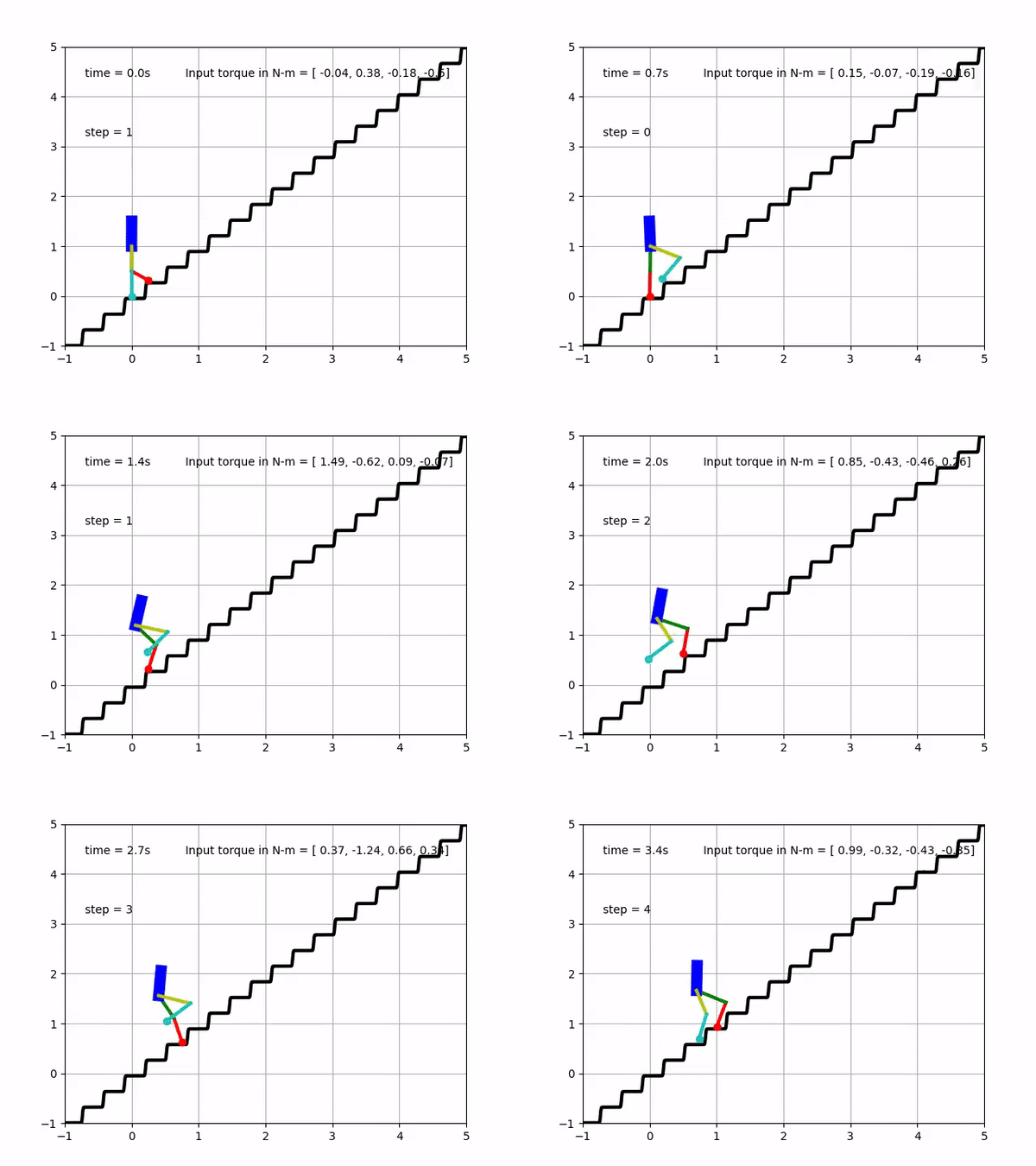
- Staired terrain: Ascending and descending stairs
- Sloped terrain: Walking up and down inclines
Passive Walking & Chaos
Explored the fascinating dynamics of 2-link passive walkers — robots that walk down a slope with no actuators, powered only by gravity:
- Poincaré maps: Analyzing fixed points and stability
- Bifurcation analysis: Studying gait transitions
- Basin of attraction: Understanding robustness to perturbations
- Chaotic dynamics: Demonstrating sensitive dependence on initial conditions
Basic Systems
The repository also includes trajectory optimization examples for fundamental systems:
- Cartpole: Swing-up control using Python (CasADi) and C++
- Simple Pendulum: Time-optimal swing using MATLAB
Results
Generated stable periodic gaits for walking speeds of 0.3-1.0 m/s. Demonstrated chaotic behavior in passive walkers and analyzed bifurcations in the gait family. Human and ostrich-style gaits were both achieved with the 5-link model.